Contents of this entry
An old enemy recognisedThe sword beside the fallen kingPrimary referencesRelated encyclopedia entries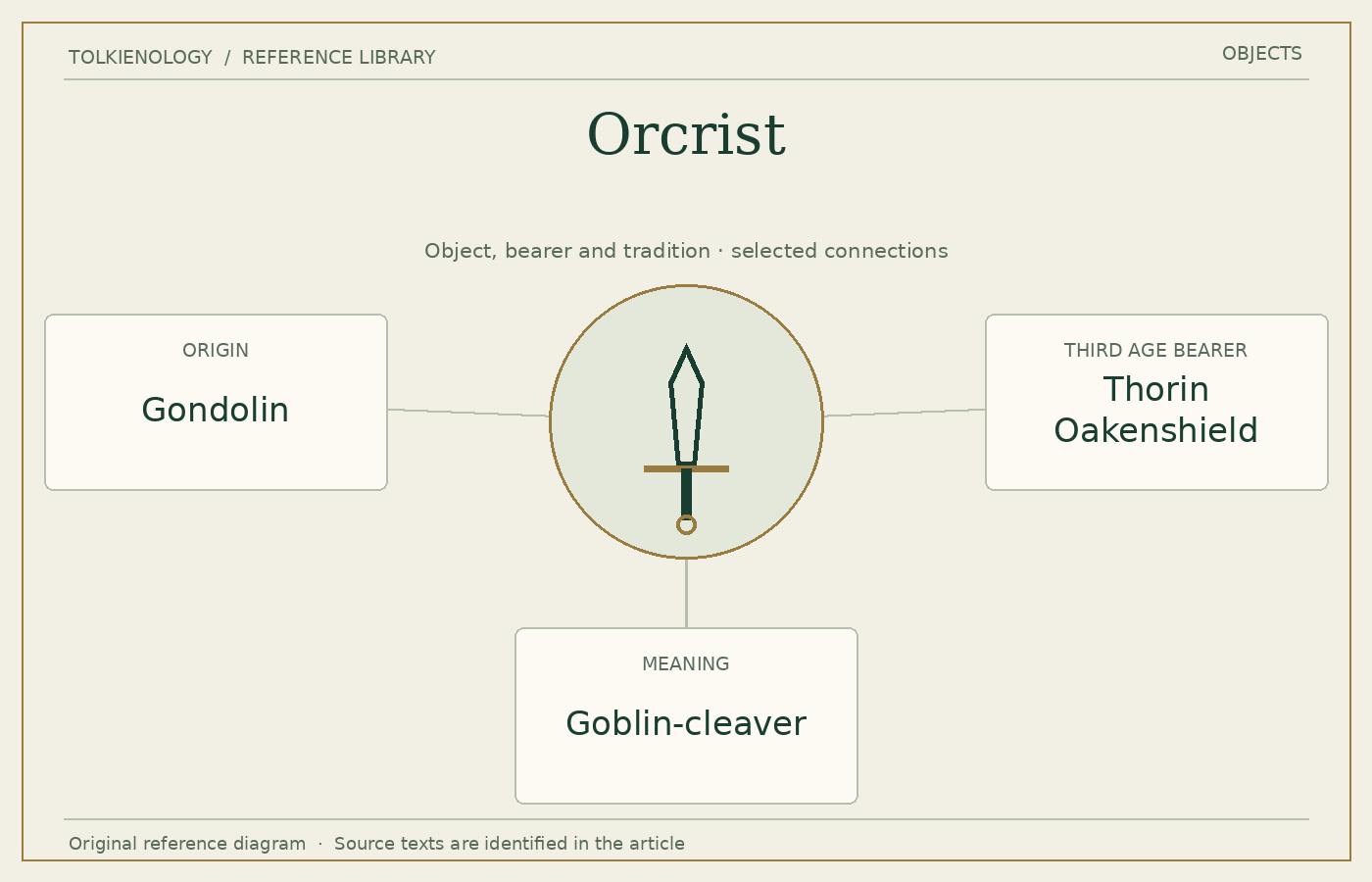
An old enemy recognised
Elrond identifies Orcrist in Rivendell, explaining its origin in Gondolin and the significance of its name. The recognition changes the meaning of the discovery. What might have been useful loot becomes an object with a history of allegiance, craftsmanship and fear.
The goblins recognise the blade’s reputation when Thorin’s company is captured. Its earlier service therefore has consequences in a later encounter without the whole original history being retold. The device is characteristic of The Hobbit: a name and an object disclose a larger world around a compact travelling story.
The sword beside the fallen king
Orcrist is taken by the Elvenking when the Dwarves are imprisoned in Mirkwood. After Thorin’s death it is placed upon his tomb beneath the Mountain. Its warning light then contributes to the security of the restored kingdom.
The sequence is important because it joins captivity, conflict and a final act of respect. The king who had held Thorin prisoner can honour him after a shared battle, and the blade’s presence in the tomb becomes more than a private possession withheld from future use.
The book does not identify every earlier bearer of Orcrist or supply the complete physical design familiar from film merchandise. A visual interpretation should be labelled accordingly. Its principal literary relationships are secure enough without filling those gaps: Gondolin provides its origin, the goblins preserve its fearful reputation, and Thorin’s final resting place gives it a new duty within the recovered homeland.
Primary references
The Hobbit, “Roast Mutton”, “A Short Rest”, “Over Hill and Under Hill”, “Barrels Out of Bond” and “The Return Journey”.