Contents of this entry
The rescue on ThangorodrimThe western host and the broken alliancePrimary referencesRelated encyclopedia entries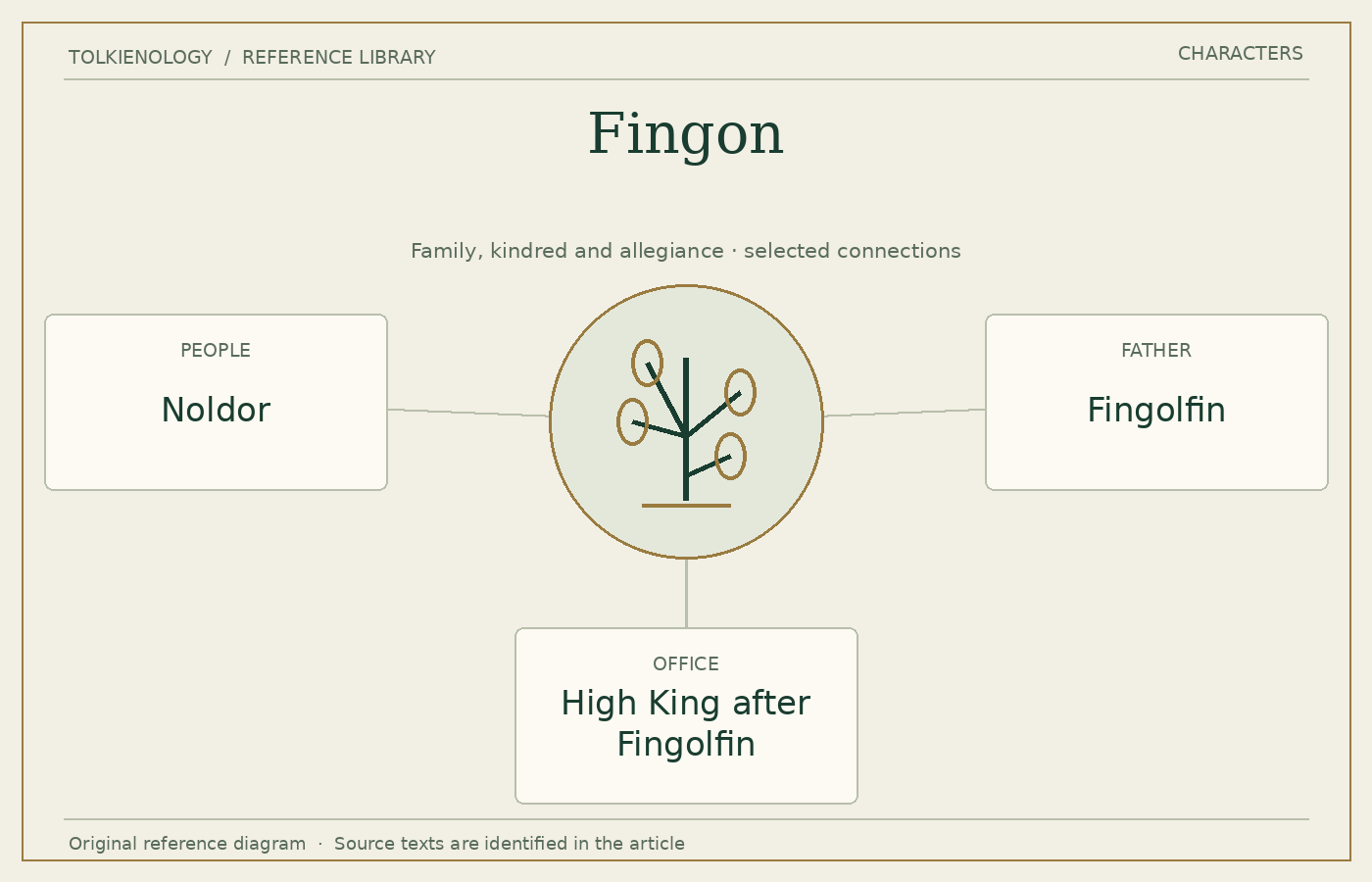
The rescue on Thangorodrim
Maedhros is held on the face of Thangorodrim after the division between Fëanor’s followers and Fingolfin’s people. Fingon undertakes a rescue despite the injuries caused by the burning of the ships. With Thorondor’s aid, he reaches the prisoner, but escape requires severing the hand bound to the rock.
The act makes possible a measure of reconciliation. Maedhros renounces his claim to supreme kingship in favour of Fingolfin, helping to establish an arrangement that can survive beyond the immediate quarrel. Fingon’s courage therefore has consequences larger than the preservation of a friend.
The western host and the broken alliance
After Fingolfin’s death, Fingon becomes High King. In the Nirnaeth, his forces form the western part of the alliance associated with Maedhros’s plans. Premature movement, the enemy’s preparations and betrayal contribute to a battle whose separate stages cannot be reduced to one error by one commander.
Fingon dies fighting the Balrogs, and the kingship passes to Turgon. His fall represents the end of a political possibility as well as a heroic life: the northern resistance can no longer be understood through the long stability of the earlier siege.
His genealogy needs explicit source labels. The published Silmarillion calls Gil-galad his son, while later materials consider a different parentage. A reference entry should record the difference rather than silently treat one family’s reconstruction as the only form Tolkien ever contemplated.
Primary references
The Silmarillion, “Of the Return of the Noldor” and “Of the Fifth Battle: Nirnaeth Arnoediad”; The Peoples of Middle-earth, “The Shibboleth of Fëanor”, editorial note on Gil-galad.