Contents of this entry
An alliance with separated movementsThe people who cover a retreatPrimary referencesRelated encyclopedia entries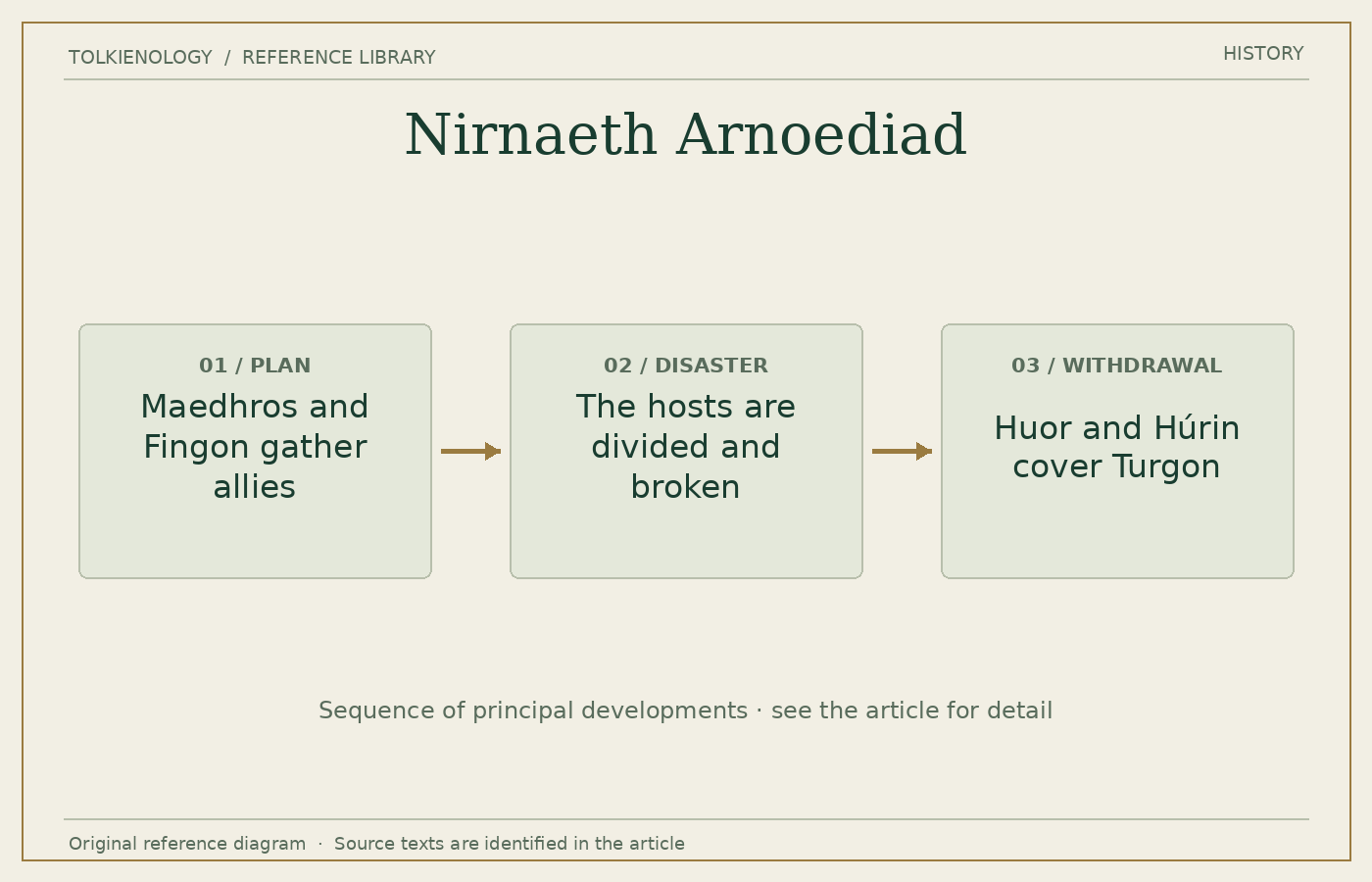
An alliance with separated movements
Maedhros’s plans require coordination between eastern and western forces. The participants bring different loyalties, histories and reasons to fight, while earlier divisions among the Elves already limit the unity that can be achieved.
The enemy exploits timing, captivity and betrayal. Premature movement and the breaking of the eastern host cannot be understood as one isolated failure by a single leader. The narrative’s several reversals show how a coalition depends on information and cooperation that no one participant can command completely.
The people who cover a retreat
Húrin and Huor defend Turgon’s withdrawal, making their own position a barrier behind which another people can escape. Huor dies; Húrin’s last stand ends in capture. The different outcomes lead into the stories of Tuor and Túrin, whose relationship as cousins is easily lost when the battle is reduced to a list of fallen kings.
The battle also changes the geography of power. Surviving settlements remain, but the possibility of restoring the earlier northern order has been gravely diminished. Fear, displacement and the loss of confidence continue after the fighting stops.
Its title is therefore more than a poetic alternative for “a large defeat”. The unnumbered tears belong to a dispersed history of households and peoples whose suffering the compressed battle narrative can only begin to enumerate. The later tales supply some of those particular lives.
Primary references
The Silmarillion, “Of the Fifth Battle: Nirnaeth Arnoediad”; The Children of Húrin, “The Battle of Unnumbered Tears”; The War of the Jewels, “The Grey Annals”.