Contents of this entry
The mountain and the place of forgingThe quest at its limitPrimary referencesRelated encyclopedia entries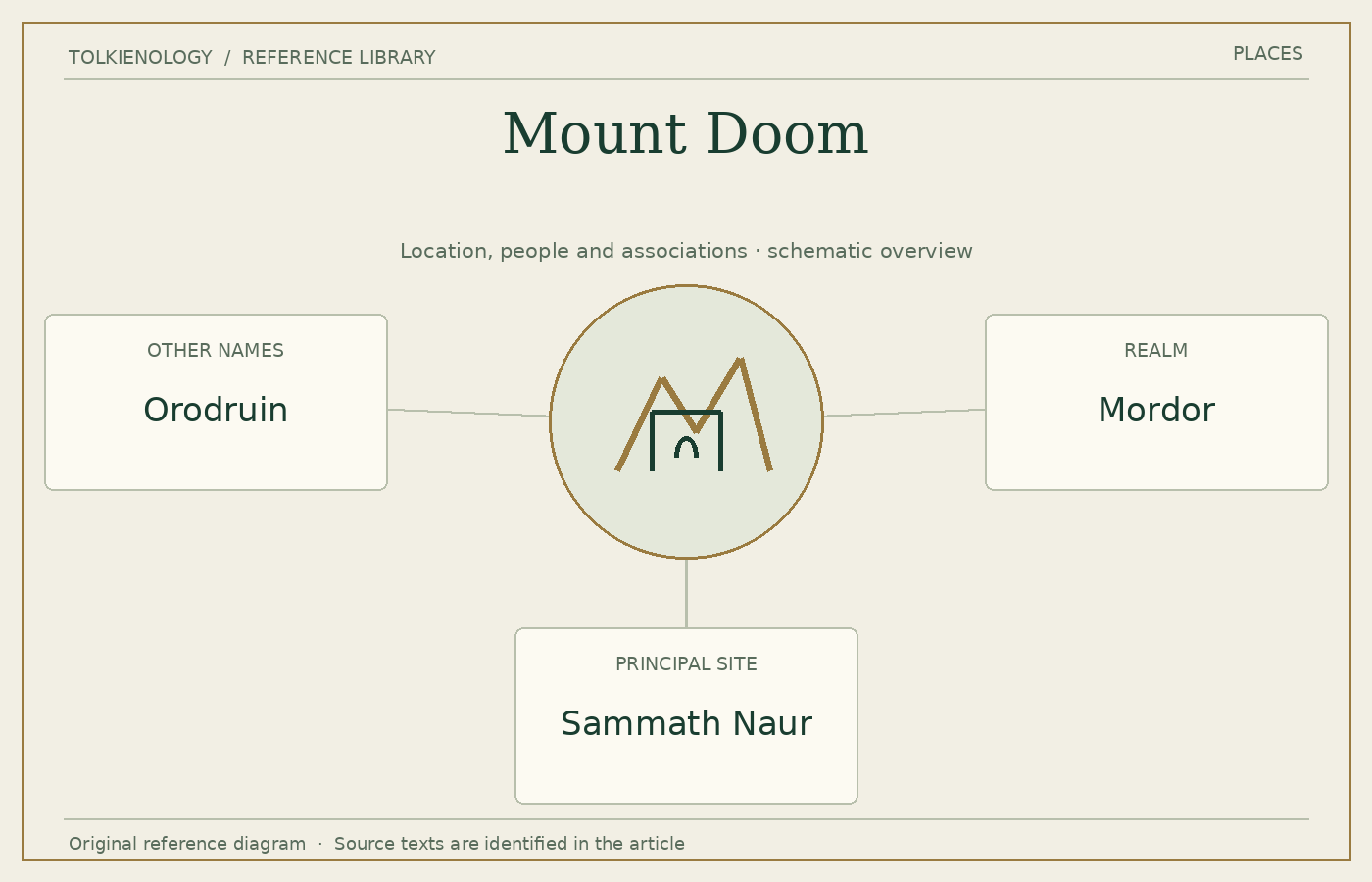
The mountain and the place of forging
The decisive site is the Sammath Naur, the Chambers of Fire, reached from the mountain’s road. The Ring’s origin establishes a particular condition of destruction. Ordinary furnaces, physical blows and even famous dragon-fire do not provide equivalent means.
The mountain’s eruptions and smoke also affect the larger landscape of Mordor. Its activity belongs to a country shaped by Sauron’s power, but the volcano should not be confused with Sauron himself or described as a creature acting with an independently narrated personality.
The quest at its limit
At the Crack of Doom, Frodo cannot voluntarily surrender the Ring. Gollum’s attack and fall complete the destruction. The sequence makes earlier mercy indispensable without making its outcome predictable to those who acted mercifully. Gandalf’s account of pity near the beginning of the novel therefore becomes significant in a form no character has fully planned.
The mountain’s destructive eruption places Frodo and Sam beyond their own means of escape. Rescue depends on others, preserving the difference between accomplishing a necessary task and possessing the power to return from it unaided.
The ending is best read with the whole journey, not used as an isolated test in which one final action erases everything preceding it. Tolkien’s letter to Eileen Elgar provides further discussion of Frodo’s limits, while the narrative itself preserves the pressure, deprivation and unequal knowledge that make those limits intelligible.
Primary references
The Lord of the Rings, Book I, “The Shadow of the Past”; Book II, “The Council of Elrond”; Book VI, “Mount Doom” and “The Field of Cormallen”; The Letters of J. R. R. Tolkien, Letter 246.