Contents of this entry
The fortress of a Ring-lordA renewed tower and a final collapsePrimary referencesRelated encyclopedia entries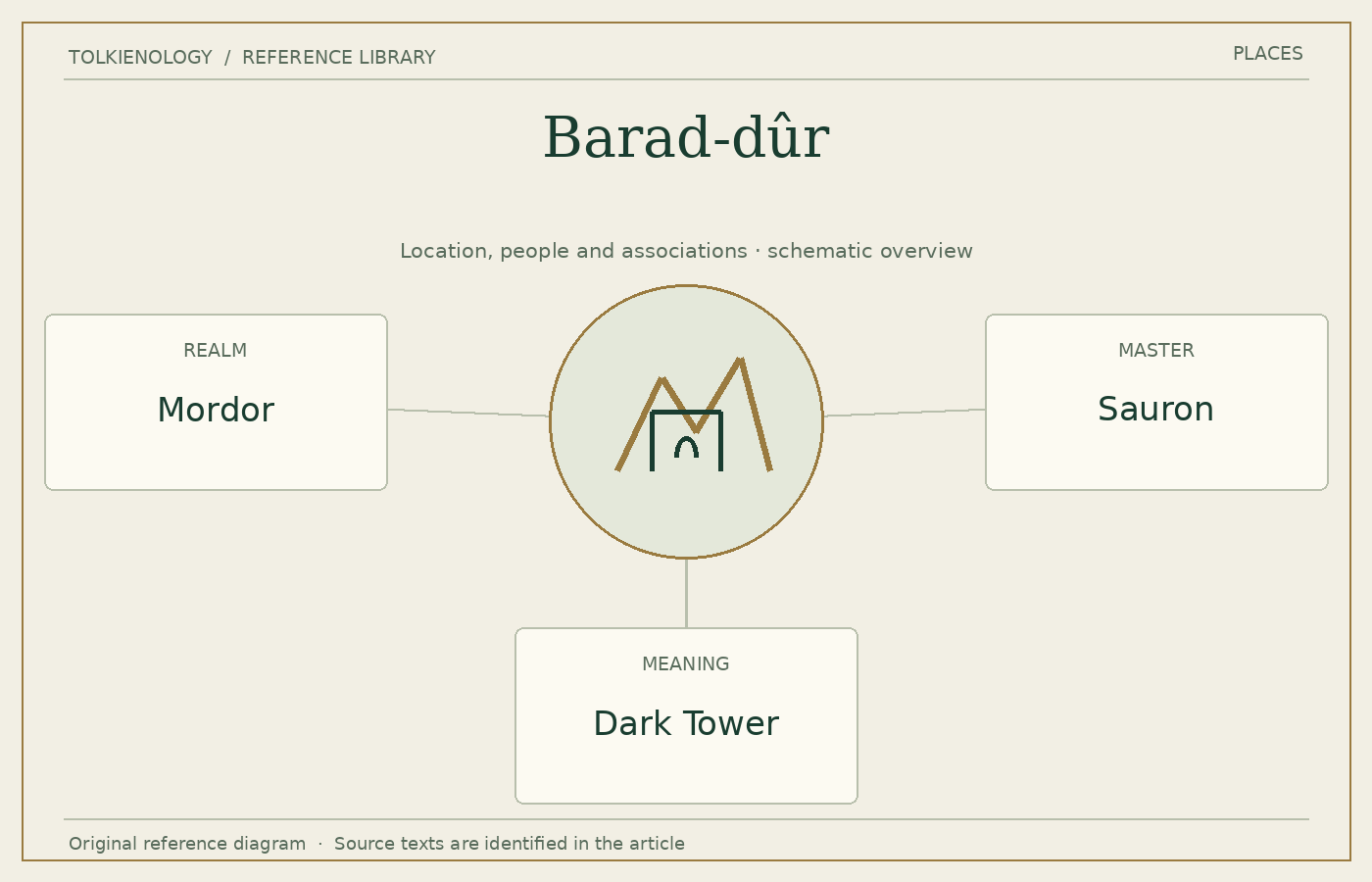
The fortress of a Ring-lord
Sauron builds the Dark Tower during the Second Age as his power in Mordor grows. Its position within the guarded land gives visible form to a rule reaching far beyond its walls. The tower belongs to an organised network of command, armies, roads and dependent territories rather than an isolated residence.
The Last Alliance defeats Sauron and overthrows the tower’s visible works. Its foundations remain because the Ring has not been destroyed. This difference explains why the Second Age victory can be both genuine and unfinished: military success does not remove the means through which the enemy has secured a possible recovery.
A renewed tower and a final collapse
In the Third Age Sauron rebuilds Barad-dûr after returning openly to Mordor. Its eventual fall follows the Ring’s unmaking, not a conventional assault by the army before the Black Gate. The distraction at the gate creates an opportunity for the quest; it does not itself breach the tower.
The Eye associated with Sauron’s scrutiny should not turn every description of the fortress into an architectural drawing of the films’ fire-eye. Tolkien’s language combines imagined physical structures with the experience of being sought and watched.
The tower’s collapse gives the end of a controlling will a material expression. Yet the story also continues beyond it, because destroying the enemy’s centre does not automatically repair the people and lands that have lived beneath its threat. Victory creates the conditions for renewal rather than making renewal unnecessary.
Primary references
The Silmarillion, “Of the Rings of Power and the Third Age”; The Lord of the Rings, Book II, “The Council of Elrond”; Book VI, “Mount Doom”; Appendix B, Second and Third Age chronology.