Contents of this entry
A dragon occupying more than a treasure chamberThe uncovered place and the unfinished questPrimary referencesRelated encyclopedia entries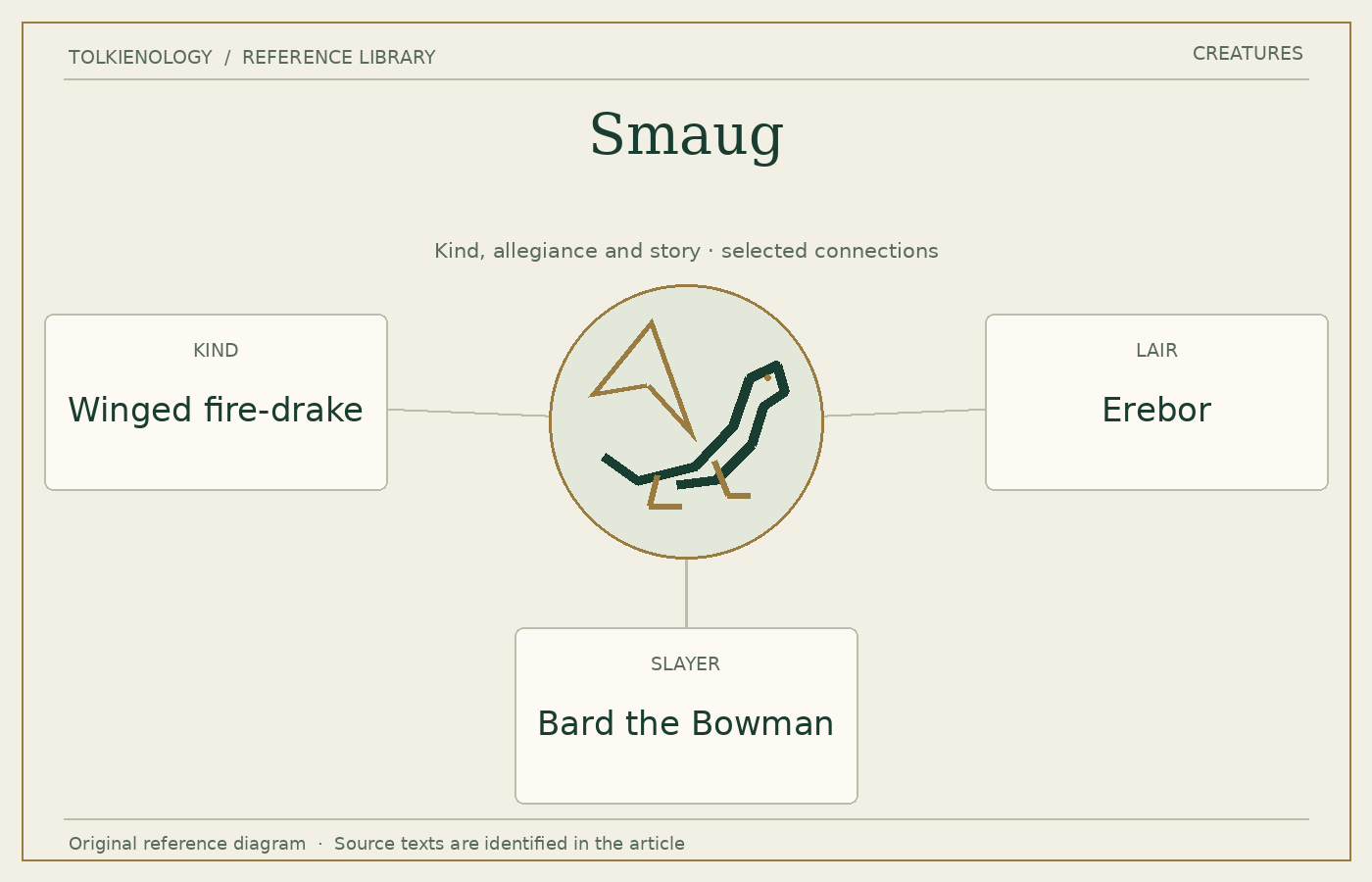
A dragon occupying more than a treasure chamber
Smaug’s attack breaks the connected worlds of the Mountain and its human neighbours. The resulting exile gives Thorin’s expedition an inherited purpose, while the ruins around the lair preserve the destruction beyond the Dwarves’ own loss.
Bilbo’s conversation with the dragon is a contest over what can be discovered without being disclosed. Riddling descriptions conceal his name but also give Smaug clues. The dragon attempts to detach the burglar from his companions by encouraging doubts about the eventual division and transport of the reward. Some of the questions are practically acute even though the purpose is manipulation.
The uncovered place and the unfinished quest
The small gap in Smaug’s armour becomes the route by which observation can matter more than a direct contest of strength. The thrush carries the information to Bard, whose final arrow kills the dragon during the attack on Lake-town.
The death does not end the book. It exposes a second conflict over the hoard, compensation and the claims of the dispossessed. “Dragon-sickness” therefore cannot be confined to an actual dragon’s presence; the habits of possessiveness continue among those who have defeated or survived him.
The book provides no exact body length. Comparative size charts that rank Smaug against every earlier dragon should identify their own conjecture rather than claim numerical authority from Tolkien. His significance in this story is already precise: he is a calculating voice as well as a destructive body, and his removal tests whether the victors can imagine a better use of what he has kept.
Primary references
The Hobbit, “An Unexpected Party”, “Inside Information”, “Not at Home” and “Fire and Water”; The Lord of the Rings, Book I, “The Shadow of the Past”; Unfinished Tales, “The Quest of Erebor”.