Contents of this entry
A battle almost fought for another reasonWhat Bilbo does not seePrimary referencesRelated encyclopedia entries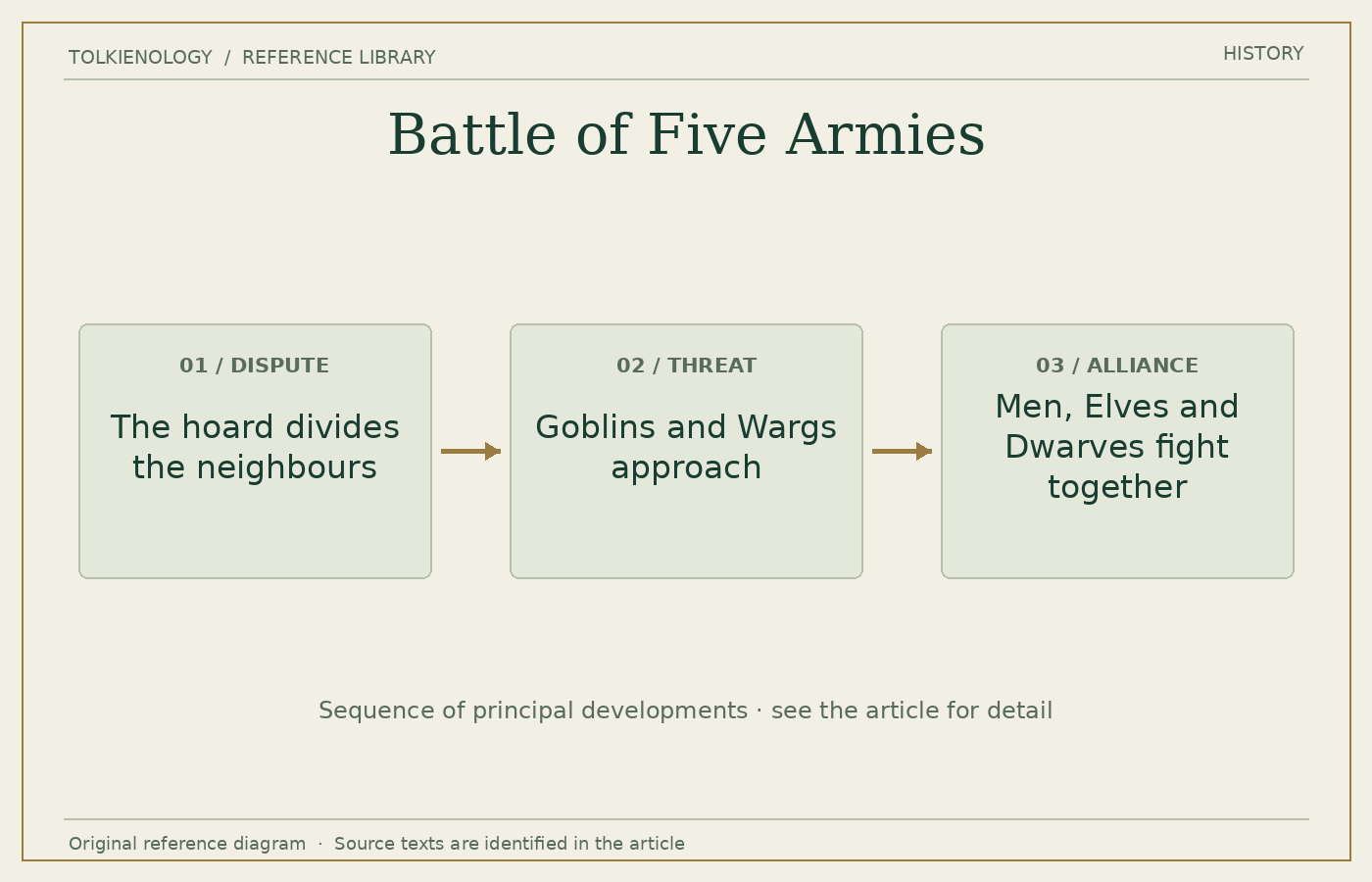
A battle almost fought for another reason
Thorin’s recovery of the Mountain has not settled the claims of the people of Lake-town or the interests of the Elvenking. The Arkenstone becomes a means of attempted negotiation, while Dáin’s arrival threatens to turn the dispute into fighting.
The goblins’ approach changes the alignment. The book’s conventional five armies are the Men, Elves and Dwarves on one side and the goblins and Wargs on the other. Eagles and Beorn provide decisive help without needing to be forced into a different arithmetic to make the title work.
What Bilbo does not see
Bilbo’s perspective remains limited. He is not placed at the centre of every military movement, and unconsciousness removes him from part of the battle. Reports afterwards supply information he cannot personally witness. This narrative choice preserves the scale of the small traveller even at the climax of a large conflict.
Thorin’s sortie, the deaths of Fíli and Kíli, the arrival of the Eagles and Beorn’s killing of Bolg all contribute to the outcome. The victory then requires settlement, mourning and rebuilding rather than ending the story at the last successful blow.
The films considerably expand the battlefield, combatants and individual confrontations. For a book reference, follow the concise account and its retrospective reports. The difference is especially important when explaining who kills whom or when particular characters reach the conflict.
Primary references
The Hobbit, “The Gathering of the Clouds”, “A Thief in the Night”, “The Clouds Burst” and “The Return Journey”; The Lord of the Rings, Appendix A, “Durin’s Folk”.