Contents of this entry
The forest and the smithThe demand to possess another's futurePrimary referencesRelated encyclopedia entries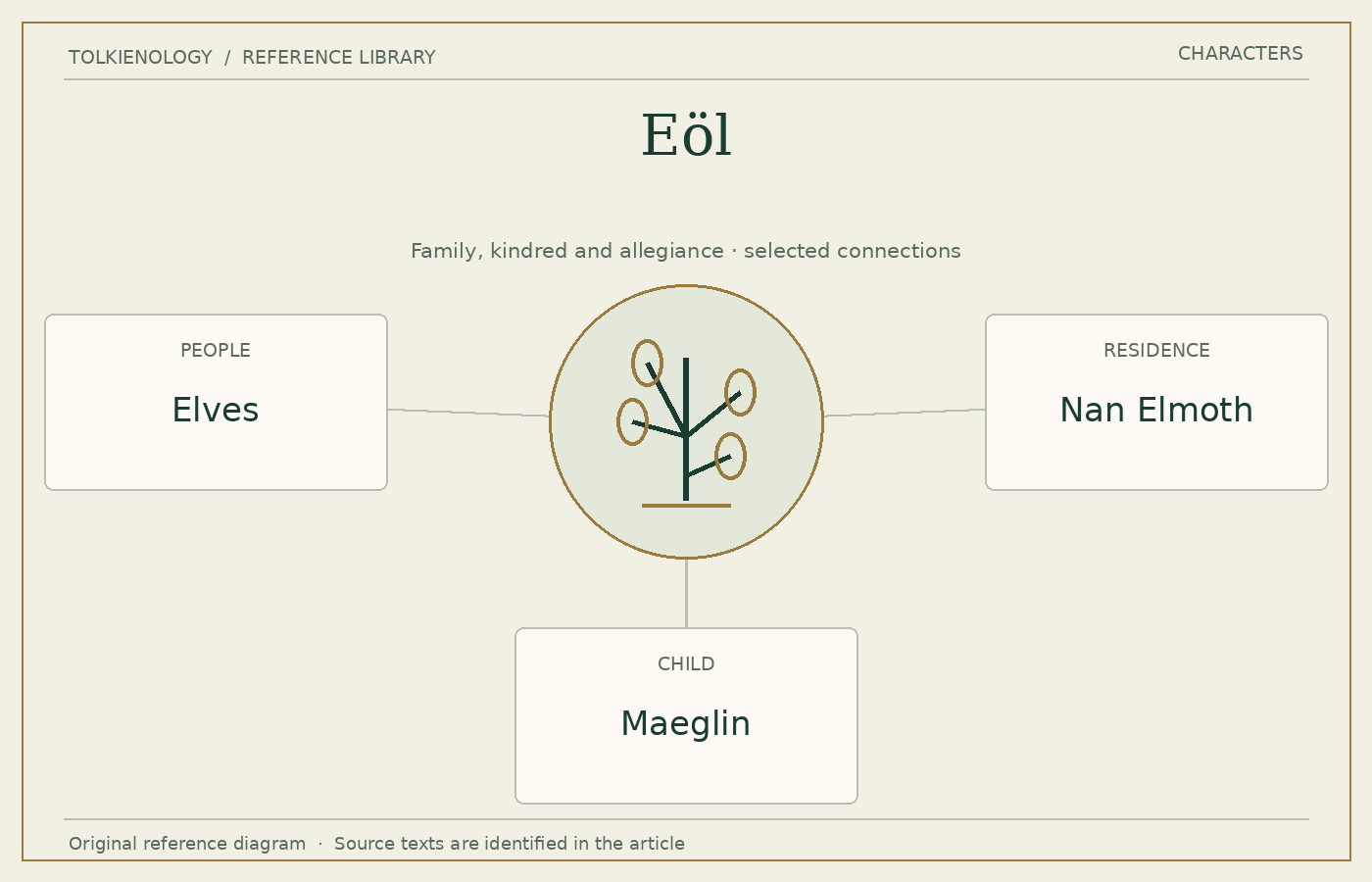
The forest and the smith
Eöl lives apart from the principal Noldorin communities and has dealings with the Dwarves. His craftsmanship includes the swords Anglachel and Anguirel and the metal galvorn. These achievements distinguish him without making skill a guarantee of generosity or just conduct.
Aredhel’s arrival in Nan Elmoth begins a household whose later restrictions become central. Maeglin learns from his father but also longs for the realm and kinship represented by his mother. When mother and son leave, Eöl follows them to Gondolin rather than accepting their departure as a choice they can make.
The demand to possess another's future
Turgon will not allow Eöl to leave with knowledge of the hidden city. Eöl responds by attempting to kill Maeglin, and Aredhel receives the poisoned weapon instead. Her death leads to Eöl’s execution, after which Maeglin remains in Gondolin.
The epithet Dark Elf must be read in its narrative and Elven historical setting. It is not a biological species label equivalent to a modern game’s stock race, nor a substitute for explaining the particular choices through which he harms his family.
The story also resists treating an unhappy outcome as evidence that Aredhel’s wish to travel or Maeglin’s wish to leave was inherently wrong. Eöl’s refusal of their independent movement is an action with its own responsibility. The later betrayal by Maeglin has further causes and decisions; it is not an inevitable hereditary trait transmitted by an evil father.
Primary references
The Silmarillion, “Of Maeglin” and “Of Túrin Turambar” for Anglachel; The War of the Jewels, “Maeglin”, for the narrative’s textual development.