Contents of this entry
Gondor's need and the journey northRepentance and the limits of a heroic reputationPrimary referencesRelated encyclopedia entries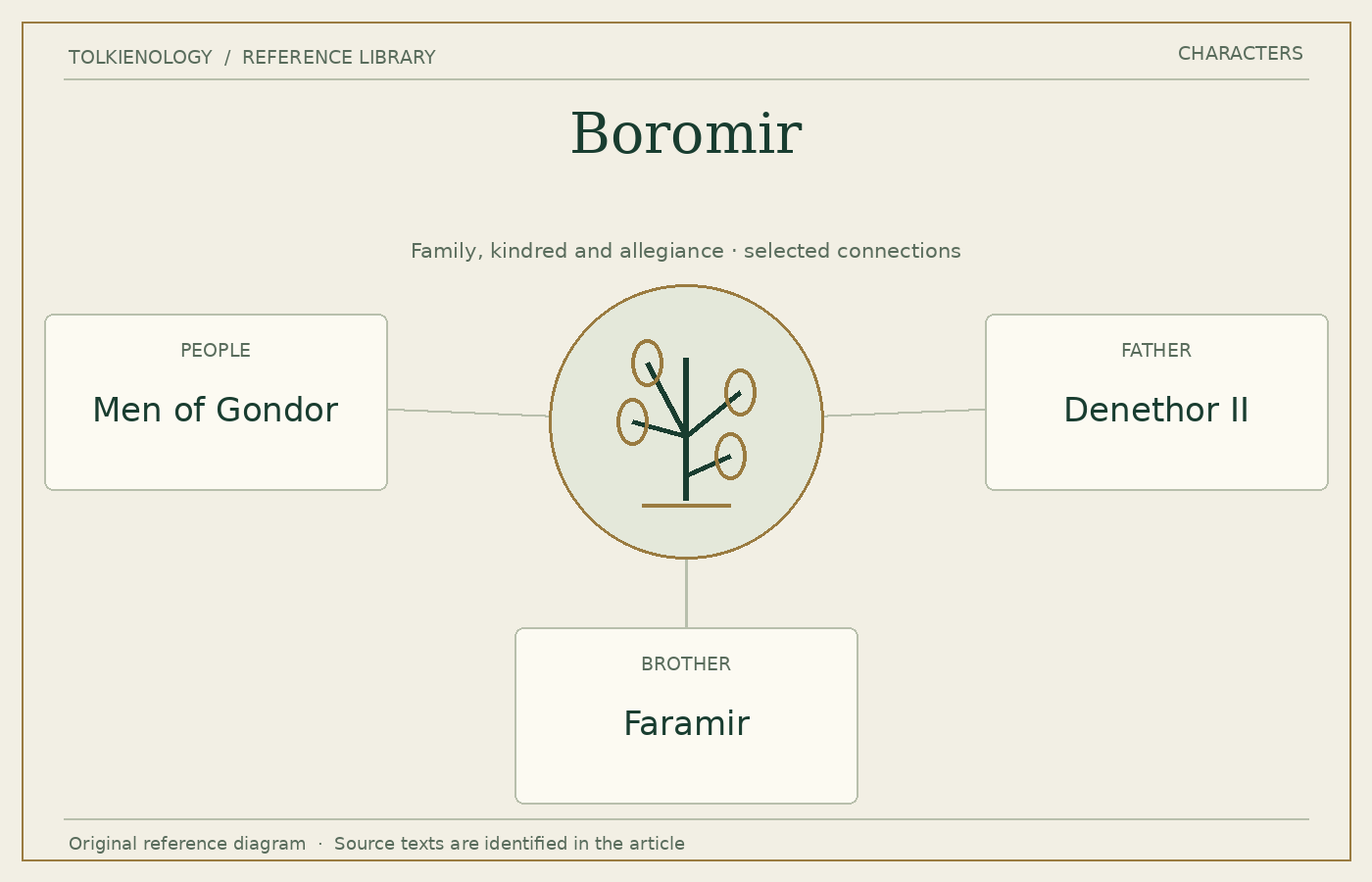
Gondor's need and the journey north
Boromir travels to Rivendell after a troubling dream points towards Imladris, a broken sword and a halfling. His arrival brings Gondor’s military crisis into the Council of Elrond. He is courageous and experienced, and his concern for the survival of his people is real. These qualities are essential to the tragedy: the Ring does not need to invent his sense of responsibility in order to corrupt its expression.
On the journey, Boromir helps his companions through practical difficulties and argues for a route through Minas Tirith. His conception of victory remains centred on defending Gondor by means of power that can be wielded. At Amon Hen he attempts to take the Ring from Frodo. Frodo escapes, and the immediate failure exposes to Boromir what he has become capable of doing.
Repentance and the limits of a heroic reputation
His final defence of Merry and Pippin is not the action of a man who has ceased to care about others. Mortally wounded, he confesses his attempt to Aragorn and asks him to save Gondor. The sequence allows failure, repentance and courage to coexist without making the attempt against Frodo harmless.
The opening of The Two Towers gives his death a different position from the climax assigned to it in Peter Jackson’s first film. The book also sets his choices beside Faramir’s later refusal. Their contrast is more informative than a division into an entirely bad brother and an entirely good one: each faces inherited expectations, and each must decide whether defence of a homeland justifies possession of an instrument of domination.
Primary references
The Lord of the Rings, Book II, “The Council of Elrond” and “The Breaking of the Fellowship”; Book III, “The Departure of Boromir”; Book IV, “The Window on the West”.