Contents of this entry
The defender of Lake-townThe king and the disputed treasurePrimary referencesRelated encyclopedia entries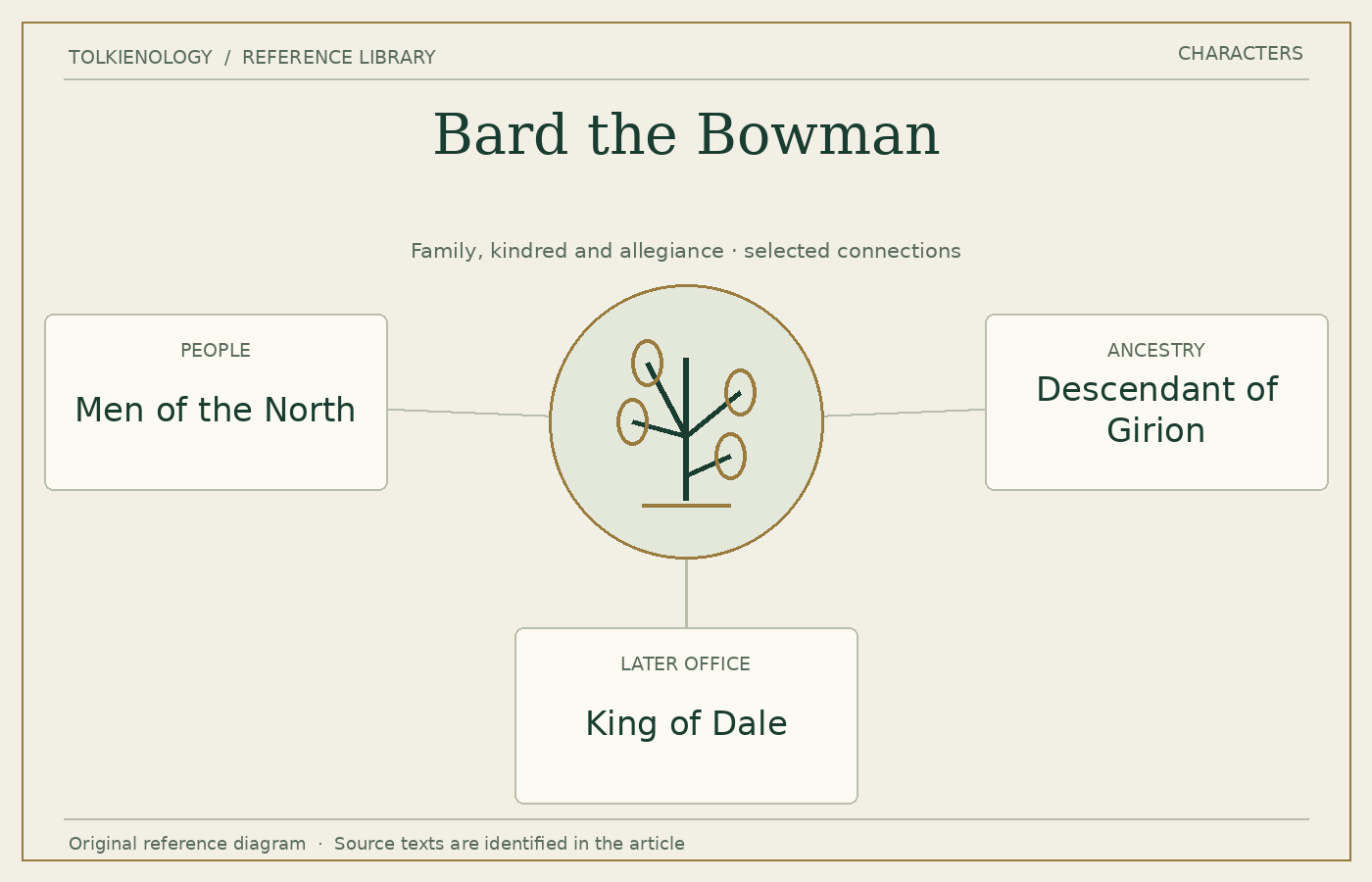
The defender of Lake-town
Bard’s reputation among his neighbours is initially coloured by his readiness to foresee disaster. During Smaug’s attack, that habit becomes vigilance rather than mere pessimism. He continues the defence when normal protection has failed, and the thrush brings knowledge of the dragon’s vulnerable place. His descent from Girion connects him to the former rulers of Dale and to the thrush’s message.
The Black Arrow supplies the final shot, but the successful defence is not narrated as the application of a generic dragon-killing technology. Courage, inherited knowledge, an unexpected messenger and attention to a particular vulnerability converge in a moment of crisis.
The king and the disputed treasure
After the destruction of Lake-town, Bard must think about survivors as well as victory. His claims to compensation and to part of the hoard come from the suffering of the community and the treasure’s earlier history. These are not interchangeable with the Elvenking’s interests or Thorin’s inherited claim, even when the parties cooperate.
Bilbo’s surrender of the Arkenstone creates a possible basis for negotiation. The coming of the goblins then forces an alliance in battle. Afterwards Bard’s use of the settlement supports rebuilding and restoration rather than a purely personal accumulation of wealth.
The Hobbit films add a much more extensively dramatised family and political background. Those scenes should be distinguished from the comparatively concentrated book account, where his judgement after Smaug’s death is as important to his character as the celebrated arrow.
Primary references
The Hobbit, “Fire and Water”, “The Gathering of the Clouds”, “A Thief in the Night” and “The Clouds Burst”; The Lord of the Rings, Appendix B, Third Age chronology.