Contents of this entry
A route beyond the ordinary roadsWhat remains after a victoryPrimary referencesRelated encyclopedia entries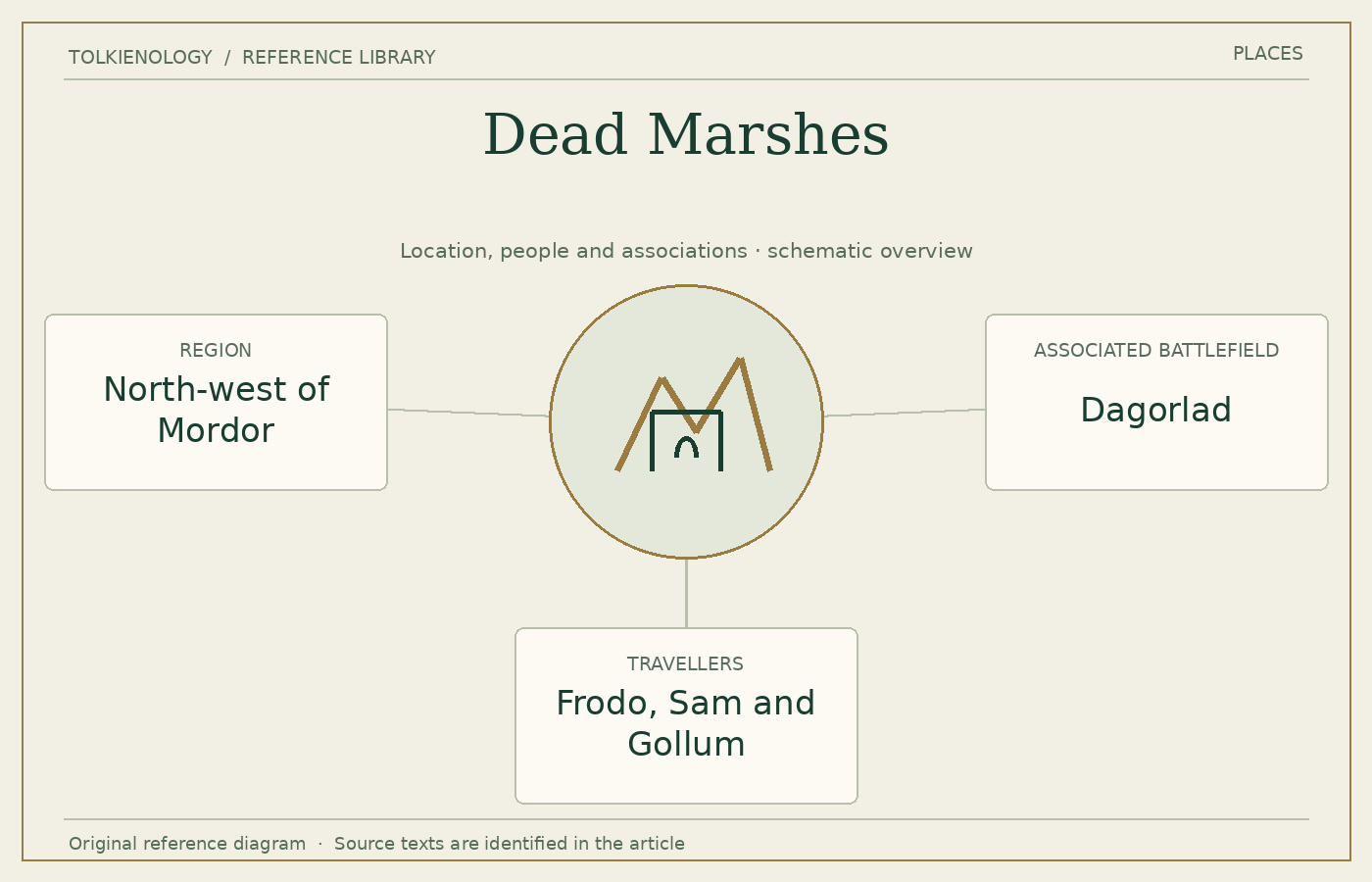
A route beyond the ordinary roads
Gollum’s knowledge offers a concealed approach, avoiding more obvious watched routes. The usefulness of the guide does not make the passage safe. Uncertain footing, pools, lights and the Ring-bearer’s vulnerability demand a different kind of vigilance from a march along a road.
The marshes have spread over part of the land associated with the Battle of Dagorlad at the end of the Second Age. Gollum’s explanation connects the faces with those who died in the war. The narrative does not require the reader to treat every image as an ordinary preserved body accessible by physical investigation.
What remains after a victory
The dead do not belong to one side alone. The vision brings together the remains or images of former enemies, allowing the battlefield to survive as an unresolved presence long after the victory remembered in political histories. Frodo and Sam encounter its danger before they could assemble a complete account of its causes.
The place is sometimes connected with Tolkien’s experience of the First World War. Such comparisons can be illuminating, but they should not replace the fictional history or claim that the wetlands are a literal map of one battlefield. A biographical resemblance is an interpretive argument, not a geographical identification.
The episode also develops the difficulty of dependence on Gollum. He knows enough to save the travellers from one danger while remaining capable of leading them towards another. Practical knowledge and trustworthy purpose are not the same qualification.
Primary references
The Lord of the Rings, Book IV, “The Passage of the Marshes”; Book II, “The Council of Elrond”, for the Last Alliance; The Letters of J. R. R. Tolkien, Letter 226, for Tolkien’s recollections concerning the imagery.