Contents of this entry
A companion whose judgement changes the questSpeech, service and the last huntPrimary referencesRelated encyclopedia entries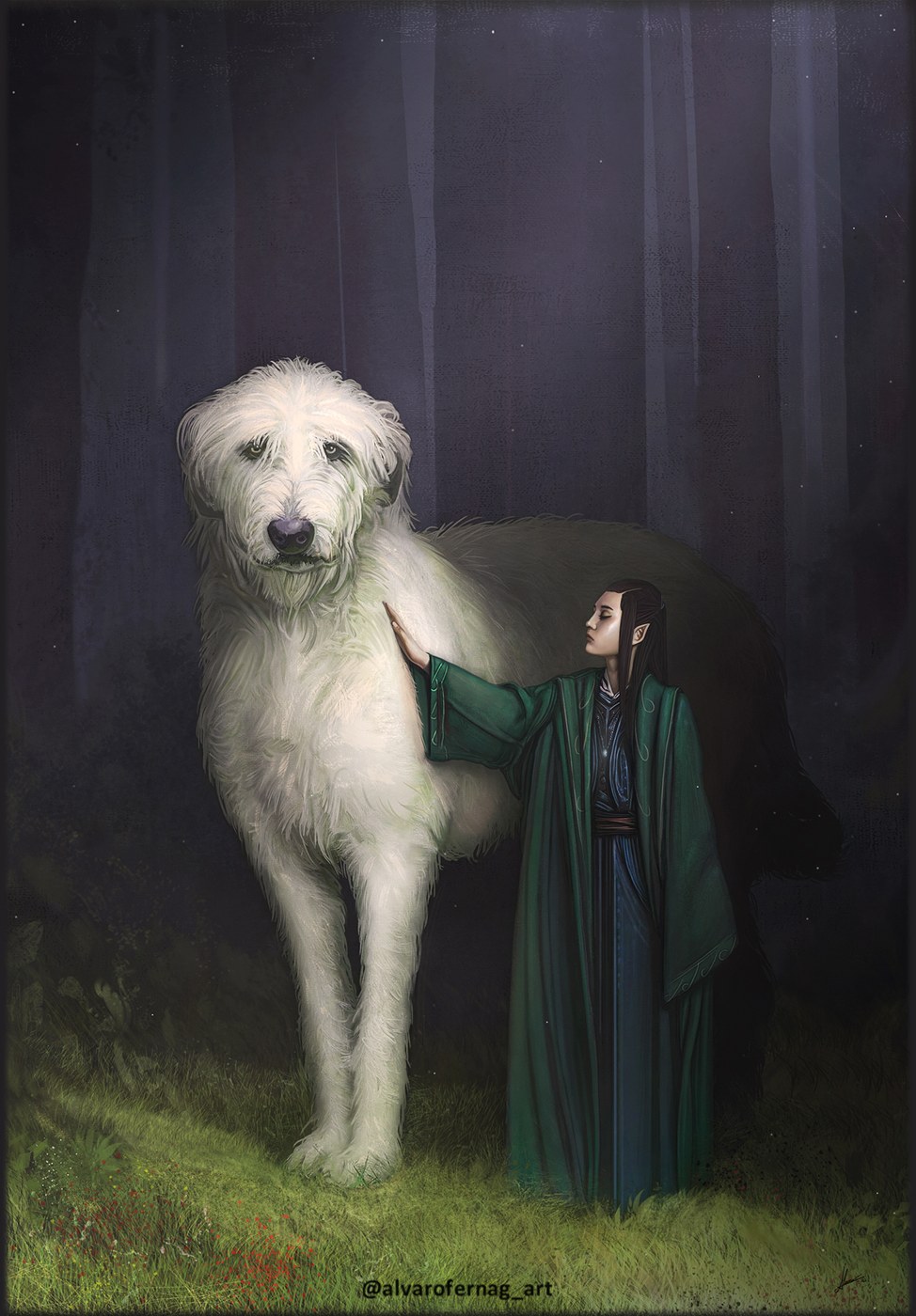
A companion whose judgement changes the quest
Huan comes to Middle-earth with Celegorm, but his encounter with Lúthien exposes the limits of obedience. He helps her escape and subsequently joins the effort to free Beren from Sauron. His strength is crucial, yet his role is not merely that of a weapon brought to a fight by someone else.
At Tol-in-Gaurhoth, Huan defeats the wolves sent against him and finally Sauron in wolf-form. The enemy attempts to exploit the prophecy that Huan will fall only before the mightiest wolf. The result demonstrates the danger of treating a partial prophecy as a mechanical formula whose conditions can simply be manufactured.
Speech, service and the last hunt
Huan is allowed to speak three times before his death. These rare acts of speech make advice and chosen assistance particularly significant. He can understand more than he ordinarily says, and the story repeatedly lets his conduct provide a moral judgement on the people around him.
His final confrontation is with Carcharoth, whose suffering and destructive power have been transformed by swallowing the Silmaril. Huan kills the wolf but is mortally wounded, fulfilling the limit that has accompanied his story.
The distinction between loyalty and submission is central to his place in the tale. He does not cease to be faithful because he refuses Celegorm’s purposes. His changed allegiance gives practical force to the possibility that a relationship can be honoured more deeply through judgement than through the execution of any command a former companion issues.
Primary references
The Silmarillion, “Of Beren and Lúthien”; Beren and Lúthien, edited by Christopher Tolkien, for the changing forms of the tale.