Contents of this entry
A power within a protected realmThe protection that cannot abolish historyPrimary referencesRelated encyclopedia entries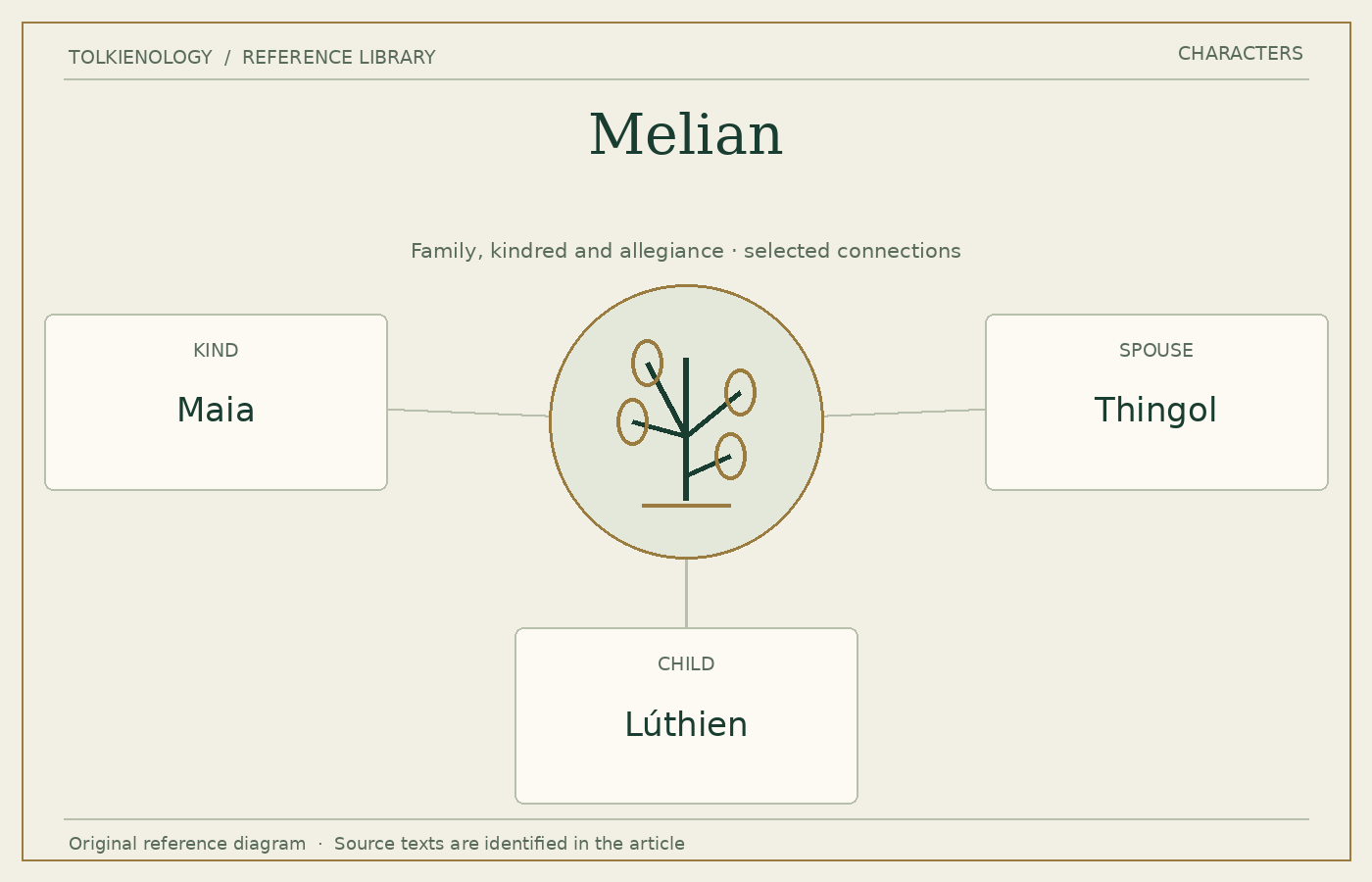
A power within a protected realm
Melian’s encounter with Elwë transforms the course of his journey. Their later kingdom is guarded by the Girdle of Melian, a power that prevents easy entry by enemies and uninvited strangers. The protection should not be confused with a continuous conventional wall or a guarantee that danger cannot arise from choices made inside the realm.
Her counsel repeatedly exposes the limits of Thingol’s judgement. She recognises more of the consequences surrounding Beren and Lúthien than a king who assumes that authority can exclude an unwanted future. Her conversations with Galadriel also connect Doriath to the partially disclosed history of the Noldor.
The protection that cannot abolish history
Doriath’s security is conditional, even when its guardian is powerful. Thingol’s desire for the Silmaril and his death bring a crisis that cannot be solved simply by increasing the force at the borders. Melian departs, and the kingdom loses the special protection associated with her presence.
Her story should not reduce her to a device explaining how a forest becomes safe. She is a counsellor, a mother and a participant in relationships whose outcomes are not all under her command. Lúthien’s eventual mortality makes this especially clear: powers older than the world encounter decisions and losses that exceed the ordinary management of a realm.
The ancestry through Lúthien carries a Maia’s place within the later genealogies, but it does not make every descendant a Maia or grant identical powers to all. The family connections need to be read alongside the different choices and destinies of its members.
Primary references
The Silmarillion, “Valaquenta”, “Of Thingol and Melian”, “Of the Sindar”, “Of Beren and Lúthien” and “Of the Ruin of Doriath”.