Contents of this entry
The limit of concealmentSurvival after the defence failsPrimary referencesRelated encyclopedia entries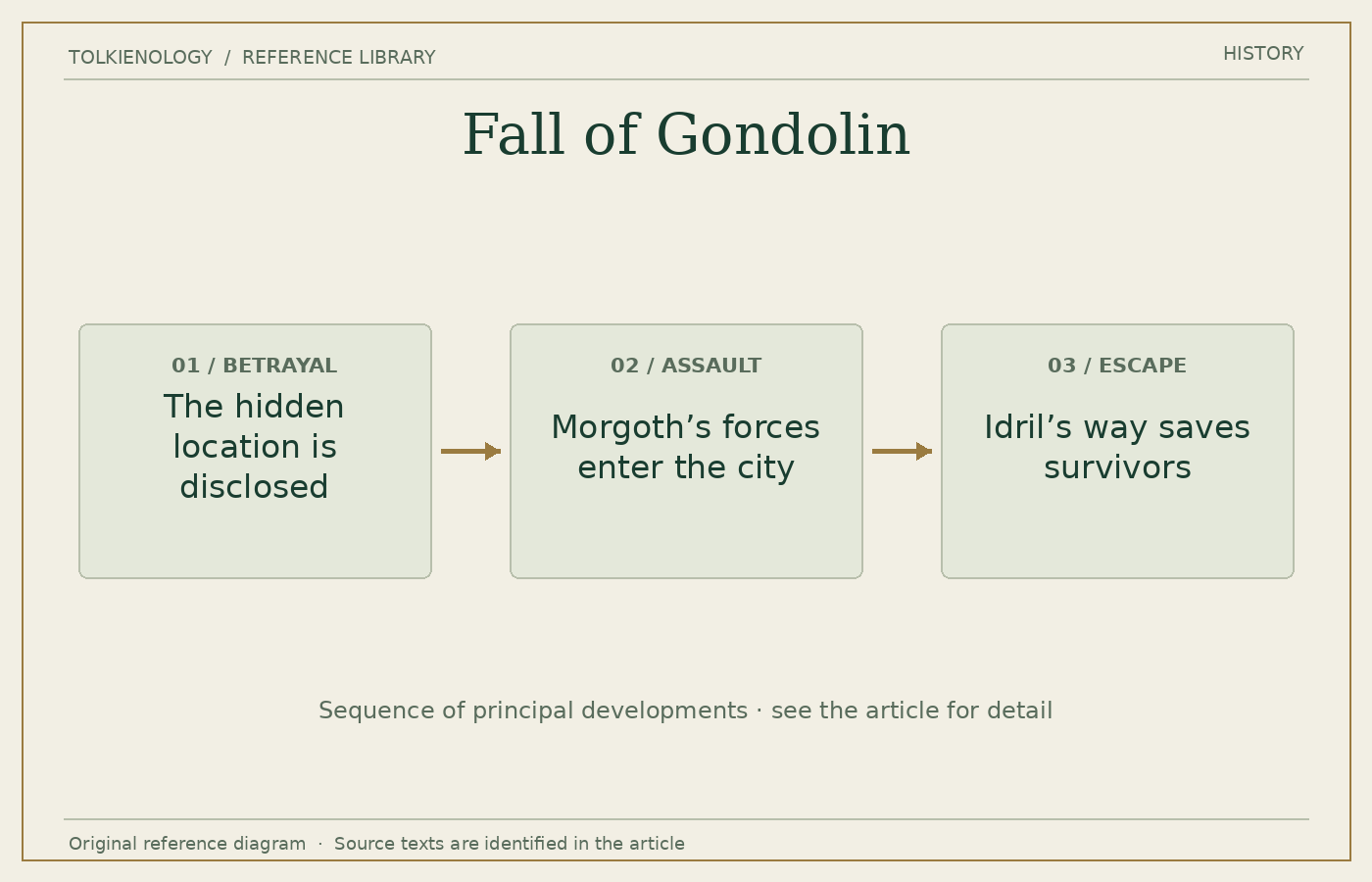
The limit of concealment
Gondolin’s long safety depends on hidden approaches and strict control over movement. Ulmo’s message, brought by Tuor, warns that these conditions cannot be relied upon indefinitely. Turgon chooses to remain, while Idril prepares a separate way of escape.
Maeglin’s capture and betrayal provide the enemy with the information the city’s secrecy has sought to deny. The attack consequently exposes a strategic weakness larger than the strength of walls: a whole system of security can depend on knowledge not passing beyond a small group.
Survival after the defence fails
Idril’s route saves lives when the city cannot be held. Tuor and the survivors fight their way out, while Glorfindel’s encounter with the Balrog protects the refugees at the pass. Eärendil’s escape has far-reaching consequences, but the rescued people should not disappear from the account simply because his later role is exceptional.
The title also names the modern edited book The Fall of Gondolin, which gathers versions of the story. The fictional event and the publication are different reference subjects. The earliest complete narrative gives details not retained or retold in the same form in later writings; the mature extended Tuor narrative stops before the fall itself.
A careful account therefore follows a named version. Mixing the earliest machines and creatures, the later approach to the city and the final Silmarillion summary without labels would produce a vivid modern reconstruction, but not an accurate representation of any one text Tolkien completed.
Primary references
The Silmarillion, “Of Tuor and the Fall of Gondolin”; The Book of Lost Tales, Part Two, “The Fall of Gondolin”; Unfinished Tales, “Of Tuor and his Coming to Gondolin”; The Fall of Gondolin, edited by Christopher Tolkien.