John Ronald Reuel Tolkien spent much of his working life teaching other people how to read old words. His own readers would eventually discover that the names, songs and half-remembered histories in his fiction were invitations to the same kind of attention. A ruined tower might preserve the memory of a kingdom. A familiar word might conceal an older language. A story told beside a fire might reach back into a world its listeners could scarcely imagine.
This biography follows Tolkien from childhood bereavement and the battlefields of the First World War to university teaching, family storytelling and the slow construction of Middle-earth. It also follows the books beyond his death, because the writer known through The Hobbit and The Lord of the Rings is only part of the author preserved in manuscripts, illustrations, scholarship and correspondence. The connections discussed here are interpretations of a documented life, not a claim that each fictional character has a single real-life original.
A life at a glance
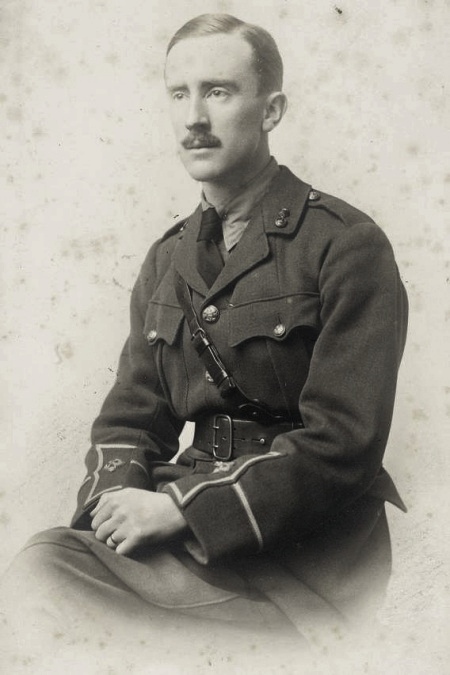
Full name: John Ronald Reuel Tolkien. Born: 3 January 1892, Bloemfontein, Orange Free State, now South Africa. Died: 2 September 1973, Bournemouth, England. Wife: Edith Mary Bratt, married in 1916. Children: John, Michael, Christopher and Priscilla. Academic appointments: Leeds, 1920–1925; Oxford, 1925–1959. Principal lifetime fiction: The Hobbit (1937) and The Lord of the Rings (1954–1955). Major posthumous publication: The Silmarillion (1977), edited by Christopher Tolkien.
Dates provide a framework, but they do not explain why this life continues to attract readers. Tolkien brought forms of knowledge usually separated by modern institutions into a single imaginative practice: historical linguistics, medieval poetry, drawing, family entertainment and sustained moral reflection. His achievement becomes clearer when these activities are allowed to illuminate one another.
Bloemfontein, Birmingham and the loss of a father
Tolkien’s parents, Arthur and Mabel, came from Birmingham. Arthur’s banking career took them to southern Africa, where Ronald, as he was generally known within the family, was born in 1892. His brother Hilary followed in 1894. Mabel brought the boys to England in 1895 for a visit; Arthur remained behind and died in February 1896. What had been a journey home became a permanent separation from the boys’ birthplace. Estate chronology, 1892–1949
The geographical outline is simple, but it already complicates the familiar image of an author rooted immovably in Oxford. Tolkien’s life began with migration and a broken family arrangement. England was both inherited home and a place to which he had been brought. His fiction would repeatedly distinguish the place where someone begins from the place that person learns to cherish, defend or recover. That resemblance is a useful biographical question, rather than proof that a particular exile in Middle-earth directly represents his childhood.
Sarehole: a remembered landscape, not a miniature Shire
For several childhood years the family lived at Sarehole, then outside Birmingham’s urban centre. Its mill and surrounding countryside belong to the geographical background against which readers often approach the Shire. The surviving site makes the association tangible: a working landscape of water, paths and human activity rather than an abstract wilderness. Birmingham’s Tolkien account
It is tempting to turn a place like Sarehole into a master key: find the mill and the Shire is explained. Tolkien’s landscape writing resists that shortcut. The Shire has its own calendars, class relations, habits, boundaries and history; its familiarity emerges from literary construction as much as from recollection. What a childhood landscape can help explain is the scale of his attention. Small places matter. A local tree or watercourse deserves a name. A world need not become important only when a king crosses it.
That scale remains crucial even in the largest episodes of The Lord of the Rings. The reader is asked to care about gardens and ordinary households before being asked to care about the survival of an age. The domestic and the epic do not cancel one another. Tolkien makes the second intelligible through the first.
Mabel, Catholicism and a second bereavement
Mabel converted to Catholicism in 1900. She died in 1904, leaving Ronald and Hilary orphaned. Father Francis Morgan, a priest associated with the Birmingham Oratory, became their guardian. His practical support and continuing presence were central to the brothers’ upbringing. Tolkien Estate biography
Religion in Tolkien’s life was therefore neither a late literary decoration nor merely an academic interest in medieval belief. It belonged to family memory, education and ordinary practice. Yet treating his fiction as a disguised catechism would lose much of what makes it powerful. The peoples of Middle-earth inhabit particular histories; they argue, misjudge and act without having an explanatory theological commentary available to them at every crisis.
A responsible reading can acknowledge Catholic commitments while still asking literary questions about mercy, providence, freedom and death. Those questions do not have to produce a one-to-one correspondence between a fictional event and a Christian doctrine. Tolkien’s letter to Robert Murray, conventionally numbered 142 in The Letters, is an important primary reference for his own account of the religious character of The Lord of the Rings. The letters guide explains how to approach such statements in context.
King Edward’s School and the discovery of languages
At King Edward’s School in Birmingham, Tolkien received an education in classical and modern languages. Latin and Greek were part of formal study; older Germanic languages increasingly became a personal fascination. He also began inventing languages. This was more than naming imaginary objects: an invented language could have sound patterns, grammatical forms, histories of change and relationships with other languages.
The distinction helps explain why an apparently small detail can occupy so much space in Tolkien’s papers. A name might need changing because it no longer belonged plausibly to the language or period assigned to its bearer. A new etymology might invite a different family relationship or an older story. To a reader primarily interested in plot, such work can look like a detour. To Tolkien it could be part of the process by which a story acquired a convincing past.
Language invention was not a single youthful phase abandoned when the novels began. As Carl Hostetter explains, the linguistic materials form a substantial, changing body of work. The scripts familiar from book illustrations are one visible part of that activity; they should not be confused with languages themselves. Hostetter on the invented languages
The T.C.B.S.: friendship before the Fellowship
Tolkien’s close school circle included Christopher Wiseman, Robert Gilson and Geoffrey Bache Smith. Their Tea Club and Barrovian Society, usually abbreviated T.C.B.S., became a setting for shared ambitions and serious conversation about art. Gilson and Smith died during the First World War. The surviving correspondence gives this friendship a historical specificity that the general phrase “inspiration for the Fellowship” cannot capture. Estate biography
The distinction matters. A fictional company of travellers is not a group portrait with the names changed. But the experience of addressing friends who understood one’s ambitions, and then living beyond some of them, belongs to the human circumstances in which Tolkien wrote. Friendship in his books often combines affection with a shared task. People are sustained by companions whose gifts differ from their own, and memories remain active after separation.
Readers seeking a fuller treatment of this period should consult John Garth’s Tolkien and the Great War. It is especially useful for resisting the idea that the legendarium appeared suddenly and completely in the trenches. The earlier poems, the war years and the later revisions have to be considered together.
Oxford and the turn towards English
Tolkien entered Exeter College, Oxford, in October 1911 to study Classics. He subsequently transferred to English and graduated with first-class honours in 1915. Exeter’s archive preserves records of his undergraduate years. Exeter College’s account
The move was intellectually consequential. Studying English in this context could mean confronting languages and literary forms very different from contemporary prose: Old English verse, Middle English romance and the comparative history of Germanic speech. Tolkien’s later academic identity grew from this combination. He was interested in the physical sound of words, the structure of texts and the distant worlds their surviving fragments implied.
His Swiss walking holiday in 1911 belongs to the same broad period of discovery. Mountains encountered in person and mountains encountered in literature offered different kinds of experience. Neither makes the other unnecessary. In Tolkien’s writing, landscapes acquire force through the meeting of sensory detail and inherited narrative expectation: a pass is a physical challenge, but it is also a threshold beyond the traveller’s known world.
Edith Bratt: a partnership with its own history
Tolkien met Edith Bratt in Birmingham lodgings. Father Francis opposed the youthful relationship and required a period without contact. Tolkien wrote to Edith on reaching twenty-one in January 1913, and they renewed their relationship. They married on 22 March 1916. The Bodleian Libraries’ account places the separation and reunion alongside the later literary association of Edith with Lúthien. Bodleian account of their relationship
Edith deserves a place in the biography beyond the label “inspiration for an Elf-maiden”. She had her own upbringing, musical interests and experience of marriage, motherhood and the environments in which the family lived. A life organised around university work and the author’s private imaginative labour was not automatically an equally comfortable social world for everyone within the household.
The fictional parallel remains moving precisely when it is not allowed to erase the person. Tolkien associated Edith’s dancing in a woodland setting near Roos during the war years with Lúthien. That recollection became part of his explanation to Christopher after her death. It connects memory and invention; it does not turn the whole of their marriage into an uncomplicated fairy tale. Letter to Christopher, 11 July 1972
The Somme and the limits of the trench explanation
Commissioned into the Lancashire Fusiliers, Tolkien served as a signals officer in France in 1916 during the Battle of the Somme. Trench fever led to his return to England later that year. Recurring illness prevented a straightforward return to front-line service. The Estate’s chronology places the military postings and early family events in sequence. Wartime chronology
War is indispensable to an account of his generation, but it cannot explain the books by itself. The legendarium draws on linguistic invention and reading that began before military service. The writing continued through civilian work, family life and another world war. Calling Mordor simply “the Somme” flattens both a historical battlefield and a fictional moral geography.
What the biography does establish is that the author who wrote about endurance, command and loss had known military service and bereavement. The literary significance still requires argument. The small traveller’s limited view, the uncertainty of news, the dependence on practical companions and the difference between surviving and returning unharmed are all questions worth pursuing in the text. They are more illuminating than a hunt for a single coded battlefield behind every landscape.
The Lost Tales and a mythology in progress
During the wartime and convalescent period, Tolkien began writing the prose stories later published as The Book of Lost Tales. Their names, framing and narrative arrangements often differ from the later Silmarillion. Christopher Tolkien published them as the first two volumes of The History of Middle-earth in 1983 and 1984. David Bratman’s guide to the series
Their importance is not that they provide an untouched final answer to everything that later became uncertain. They make change visible. Tolkien’s mythology had a history of its own: episodes were expanded or displaced, cosmological questions reconsidered, genealogies altered, prose rewritten as poetry and poetry returned to prose.
This working history challenges the popular image of a creator consulting a completed private encyclopedia. Tolkien certainly sought consistency, but consistency was a task, not a starting condition. Some of the most interesting questions arose because a convincing older story and a convincing later story did not fit comfortably together. The books guide explains where readers can follow those revisions without mistaking an early draft for a later resolution.
The dictionary and the discipline of evidence
After the war Tolkien worked on the Oxford English Dictionary. Lexicography required attention to documentary evidence: the recorded uses of words, their forms, meanings and histories. Rachel A. Fletcher’s study of surviving quotation slips shows why even small archival items can matter to the reconstruction of this work. Fletcher, Journal of Tolkien Research
A dictionary entry and a fantasy narrative may appear to belong to unrelated worlds. Both, however, ask a reader to move between a small surviving form and a much larger history. An obsolete word can indicate a lost practice or a relationship between languages. An old place-name can outlast the people who first understood it. Tolkien’s fiction repeatedly makes that kind of survival available to the imagination.
The connection should not obscure the difference between evidence and invention. In scholarship, a reconstruction must answer to surviving records. In fiction, Tolkien could invent the records and the histories behind them. Much of the fascination lies in his ability to make the second feel as though it had been subjected to the first.
Leeds: teaching, collaboration and medieval texts
In 1920 Tolkien joined the University of Leeds, becoming a professor in 1924. He worked with E. V. Gordon on an edition of Sir Gawain and the Green Knight, published in 1925. University collections preserve letters and other materials from this period. University of Leeds
The Leeds years show a young professional building a career while continuing private imaginative work. Editing a medieval poem demanded a combination of close linguistic argument and responsiveness to literary form. A difficult word mattered, but so did the effect of a scene and the organisation of a whole work.
That combination helps explain why “professor” and “storyteller” are inadequate when used as rival descriptions. Tolkien did not have to stop being interested in how literature worked when he entered the classroom. Nor did his fiction have to become a scholarly exercise simply because it was written by someone who knew medieval languages. The two activities were distinct, but the skills could travel between them.

Oxford, philology and the professor’s working life
Tolkien returned to Oxford in 1925 as Rawlinson and Bosworth Professor of Anglo-Saxon and a fellow of Pembroke College. In 1945 he became Merton Professor of English Language and Literature. He retired in 1959. These appointments formed a long working life of teaching, supervision and administration alongside research and fiction. Estate’s later chronology
Philology is often reduced in introductions to a taste for unusual vocabulary. Tom Shippey’s account gives a more useful foundation: languages develop through time and have historical relationships that can be investigated. For Tolkien, names and literary traditions could preserve traces of that development. Shippey on philology
The imaginative consequence is that Middle-earth feels inhabited before the opening chapter and beyond the final page. Different speakers do not merely use different labels for the same thing. A name can reveal who remembers a place, who conquered it and which past a speaker recognises. That is one reason the books reward rereading: what first appears to be decorative depth can later become a meaningful relationship.
Beowulf and the argument for reading a poem as a poem
On 25 November 1936 Tolkien delivered his British Academy lecture Beowulf: The Monsters and the Critics. Its lasting intervention was to insist that the poem’s monsters and literary structure deserved serious critical attention, rather than treating the text chiefly as a container for historical information. Shippey’s account of Tolkien’s essays
The lecture is a useful corrective to a narrowly antiquarian image of Tolkien. He knew how much historical knowledge could illuminate an old text, but he also asked what the poem made from its materials. The existence of sources did not exhaust the significance of their arrangement. A dragon could matter as part of a shaped confrontation with mortality, not merely as a specimen of inherited folklore.
The same standard should be applied to his fiction. Discovering a parallel in an earlier romance or a northern legend begins an interpretation; it does not complete one. The question is what Tolkien’s work does with a borrowed motif, and how its position in a new story changes its force.
C. S. Lewis and the Inklings
At Oxford Tolkien formed a close friendship with C. S. Lewis. Their shared interests in older literature helped sustain conversations and the informal literary gatherings associated with the Inklings. Lewis became an important reader and encourager of Tolkien’s developing fiction. Estate biography
Their friendship is often simplified into a partnership of identical minds. They were different writers with different habits, temperaments and imaginative projects. Tolkien’s carefully revised mythology and Lewis’s fiction cannot be treated as interchangeable products of an Oxford school. The differences help explain why encouragement mattered: another reader could recognise the ambition of an unfinished work without writing the same kind of book.
The Inklings also place Tolkien’s writing in a social setting. A manuscript was heard as well as read. Passages had to hold attention in a room, and responses could be immediate. The solitary maker of maps and linguistic notes was also a writer testing narrative movement, humour and emotional effect before listeners.
A father tells stories: the other imaginative household
Tolkien and Edith had four children: John in 1917, Michael in 1920, Christopher in 1924 and Priscilla in 1929. The family audience mattered to works that did not begin as commercial projects. The illustrated Father Christmas letters, for example, combine invented voices, visual jokes and a continuing domestic performance. Baillie Tolkien on the Father Christmas letters
These creations deserve attention in their own right. They show an author enjoying scale, absurdity and the freedom of an immediate audience. A reader who knows only the more solemn passages of the legendarium may be surprised by the comic energies elsewhere in his writing. Humour was not something Tolkien had to outgrow before becoming the author of The Lord of the Rings.
The family context also discourages a false separation between serious invention and entertainment. A story can amuse a child while requiring considerable verbal and visual ingenuity. The later public identity of “Tolkien” can make all early work look like preparation for a monument. In the household, the next listener and the next occasion could be enough reason to make something new.
The Hobbit: an unexpected public doorway
The Hobbit appeared on 21 September 1937. Elaine Griffiths and Susan Dagnall helped bring the manuscript to the attention of George Allen & Unwin; Stanley Unwin’s son Rayner supplied a young reader’s report. Tolkien also contributed maps and illustrations. John D. Rateliff on the book’s development
Bilbo’s story works because the reader does not need a complete history of the world before leaving Bag End. The central experiences are immediately intelligible: discomfort, embarrassment, curiosity, fear and the discovery that established habits may conceal unused capacities. The older world becomes visible in glimpses, rather than arriving as an entrance examination.
The book also complicates the assumption that Tolkien’s heroes succeed through superior force. Bilbo’s usefulness is not reducible to martial prowess. His judgement can put him at odds with the company he has joined. Readers of the later work can recognise important continuities here without pretending that the meaning of the Ring had already reached its final form in the first edition.
Writing The Lord of the Rings: discovery over many years
Tolkien began the sequel requested after The Hobbit in late 1937. The principal narrative took shape over the following years, reaching completion in 1949, with further revision and publication work still to come. Drafts reveal discarded names, different arrangements and characters whose roles changed as the story developed. Estate account of the novel
This history matters because the finished narrative can appear inevitable. Its patterns of recurrence and fulfilment encourage a reader to imagine the whole design existing from the first sentence. The manuscripts reveal a writer finding solutions, revising assumptions and making earlier material answer to later discoveries.
Christopher Tolkien was an important reader during the Second World War, including while serving overseas. His father’s wartime letters place imaginative progress beside ordinary family concerns and world events. A letter can move between the next stage of a hobbit’s journey and anxiety about a son. Letter of 30 April 1944
The resulting book allows an unusually wide range of narrative scales to coexist. One chapter may depend on a private act of patience, another on the movement of an army, another on an ancient promise. The achievement lies partly in making those scales morally dependent on one another. Large public victories do not render small acts irrelevant; the story keeps returning to the conditions that make either possible.
Fantasy, sub-creation and the possibility of consolation
Tolkien delivered On Fairy-stories at St Andrews in 1939; the expanded essay was published in 1947. It develops his account of fantasy and the making of a convincing secondary world. Its ideas include recovery, escape, consolation and the sudden turn he called eucatastrophe. Verlyn Flieger on the essay
The biographical importance is that Tolkien thought seriously about the kind of art he practised. He did not regard imaginative literature as a holiday from all intellectual responsibility. A made world asks for an internal credibility, and its distance from the everyday can change how the everyday is perceived.
Consolation in this context need not imply that nothing has been lost. A joyful turn can be powerful because suffering has been taken seriously. Readers can test that distinction in the endings of The Hobbit, The Lord of the Rings and the shorter stories. The experience is richer than a universal formula for “happy endings”, and it does not remove the need to examine how each particular story earns its conclusion.
Publication, readers and an uncomfortable fame
The Fellowship of the Ring and The Two Towers were published in 1954, followed by The Return of the King in 1955. Three physical volumes accommodated one work, internally divided into six books. The practical publication arrangement is the origin of its familiar but imprecise description as a trilogy. Publication chronology
Success changed the conditions of Tolkien’s working life. A private mythology now generated public questions. Readers wanted explanations, sequels, pronunciation guidance and authoritative answers about events that had not necessarily received a final written form. The correspondence became one place where enthusiasm, curiosity and scholarly exactness met.
Those letters remain valuable precisely because they are occasions of thought rather than a perfectly uniform reference manual. The author can clarify an intention, consider an objection or explore a hypothetical possibility. A careful reader asks whether he is describing a settled text, remembering its composition or thinking beyond it. The guide to Tolkien’s letters offers routes into this unusually rich part of his work.
Trees, machinery and the difficulty of belonging to modernity
Tolkien’s affection for trees and his hostility to destructive uses of machinery are conspicuous in his fiction and correspondence. Yet an account of his life should resist making him an uncomplicated emblem of escape from the twentieth century. He was a modern author, a university professional and a writer whose imagined worlds circulated through modern publishing.
The more useful question is what he asks readers to notice. In the fiction, instrumental ways of seeing can make a living thing valuable only as fuel, property or means to an end. The moral problem is larger than the presence of a machine. A character can treat another person’s will as something to manage or exploit even without touching a tool.
That connection between domination and the reduction of persons or places helps explain why environmental readings and readings about political power often meet in Tolkien. It is an interpretive relationship to be demonstrated in particular passages, rather than a slogan that makes all industrial activity equivalent or all imagined older societies innocent.
Retirement, Edith’s death and the return to Oxford
Tolkien retired in 1959. He and Edith moved to the Bournemouth area in 1968. Edith died in November 1971; he then returned to Oxford and accommodation associated with Merton College. Tolkien died in Bournemouth on 2 September 1973, aged eighty-one. They are buried together in Wolvercote Cemetery, Oxford, with the names Beren and Lúthien added to their gravestone. Estate chronology
The final years can look, from the perspective of publication, like a race to finish The Silmarillion. That was a real unfinished ambition, but it should not swallow the rest of the life. Family, grief, friendship, health and the demands of public recognition all belonged to the same years as the manuscripts.
The names on the grave create a remarkable meeting of literary invention and personal remembrance. A reader does not need to treat the fictional love story as a literal account of the marriage to understand the gesture. Tolkien had made a vocabulary through which he could express something about his own loss. The world invented across decades had become a language for speaking about the person with whom much of that life had been shared.
Christopher Tolkien and the life of the manuscripts
Christopher Tolkien edited The Silmarillion for publication in 1977, followed by Unfinished Tales in 1980 and the twelve volumes of The History of Middle-earth between 1983 and 1996. These books have different purposes: a continuous presentation of the mythology, a selection of unfinished writings, and a documentary account of textual development. They should not be read as interchangeable instalments of one completed series. Christopher Tolkien on Unfinished Tales
The archival record is also distributed across institutions. Marquette University holds manuscripts and working drafts for The Hobbit, The Lord of the Rings, Farmer Giles of Ham and Mr. Bliss; the Bodleian Libraries preserve another major body of Tolkien papers. The physical survival of drafts is one reason scholarship can move beyond recollection and speculation. Marquette collection description
The posthumous author is consequently encountered through editorial decisions as well as original sentences. Choosing which version to print, how to arrange fragments and how much commentary to supply affects a reader’s understanding. Christopher’s work is indispensable to the modern experience of Tolkien, and recognising its role makes that experience more precise rather than less authentic.
How to read Tolkien’s life without reducing his books
Biography helps readers recover the labour and circumstances behind a famous name. It can show why a language mattered, when a manuscript was written and whom an author was addressing. It becomes less useful when every fictional object is assigned a single autobiographical cause. A ring, a mountain or a friendship can carry meanings that exceed any one occasion in the writer’s life.
The strongest way forward is to let biography and reading question one another. Read a letter beside the chapter it discusses. Compare a recollection with a dated draft. Notice when an interpretation belongs to the author and when it belongs to a later scholar. A biography of Tolkien is most useful when it invites those investigations.
Begin with the reading order guide if the books are new to you. Use the books library to distinguish stories, editions and manuscript collections. Turn to Tolkien Studies for scholarship and to the letters for the writer’s changing, conversational voice. Tolkien’s life becomes more interesting as those paths open, not because they all lead to a single explanation, but because they reveal how much one working life could contain.
Sources and further reading
Documentary sources used for this account: the linked Tolkien Estate biography and chronological records; Exeter College’s archival account; University of Leeds collection information; the Bodleian Libraries’ account of Tolkien and Edith; Marquette’s manuscript collection description; the individual letters linked above; and Rachel A. Fletcher’s research on the dictionary quotation slips. Literary connections not attributed to those sources are this article’s interpretations.
For sustained study: Humphrey Carpenter, J. R. R. Tolkien: A Biography; John Garth, Tolkien and the Great War; Christina Scull and Wayne G. Hammond, The J. R. R. Tolkien Companion and Guide; Catherine McIlwaine, Tolkien: Maker of Middle-earth; and The Letters of J. R. R. Tolkien, edited by Humphrey Carpenter with the assistance of Christopher Tolkien, including the revised and expanded edition. These are further-reading recommendations, not a claim to have consulted every page of each volume for this article.